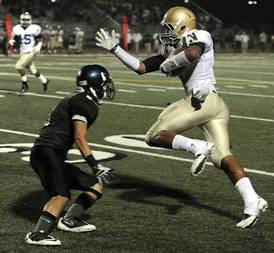
Since the last installment, we’ve been (almost) given the gift of a four-team playoff postseason to begin in a couple of years. Â Since that still-not-entirely-final announcement, the discussion has mostly shifted to how the four teams should be chosen, a question that–despite sanctimonious column after sanctimonious column to the contrary–has no right answer. Â Everyone has a good point in this argument, and whatever is decided will still result in at least some amount of controversy. Â But it will be a slightly better brand of controversy than what we have now, and that’s a good start.
But perhaps doing more to end that controversy would be the long-theorized and even longer-overdue secession of the top conferences from the NCAA. Â This move–or at the very least, the creation of a new division within the current structure–would finally acknowledge the obvious: Utah State, Tulane and Buffalo are not on the same level as USC, LSU and Ohio State.
With the most recent realignment moves, the so-called “Big Six” conferences will house 78 programs by 2015 when Navy begins play in the Big East. Â The remaining 42 (not counting a handful of announced FCS upgrades) belong to the mid-majors. Â Of those 42, exactly zero are in the top 25 in winning percentage for the past ten years (www.stassen.com). Â Every mid-major that would have been in that category has already been snatched up by a Big Sixer (Boise State, TCU, Utah) or opted for independence (BYU), which essentially gives them the same competitive benefits that Notre Dame enjoys. Â Just one has appeared in a BCS bowl and that’s Hawai’i, the remaining mid-major with the highest winning percentage in the last decade.
To put it bluntly, they wouldn’t be missed.
Further, I would suggest tossing the Big East into that pool as well. Â Of the bottom 15 teams from Big Six leagues on that 10-year list, four are Big East teams (all new additions even). Â Each of the other conferences has two, and Army is the lone independent to rank that low. Â If the separation were to finally occur, I have no doubt that Boise, Louisville, Cincy, Navy, USF, Houston, UConn and Rutgers could find homes in the Big Five or be successful as independents. Â But ultimately, as long as Boise and Navy can, the rest are expendable.
From here we can finally get to a playoff that works, without getting too out of hand for you crybabies that don’t want a two-month 64-team extravaganza of football awesomeness. Â With five conferences of sizes that will probably range from 12 to 16 teams and a few independents, a four-team playoff gets a little awkward. Â You’re either leaving one conference champ out entirely or subjecting the whole thing to another goofy mishmash of polls and computer formulas. Â Neither of those options will be acceptable at this point. Â The only realistic answers are either an 8-team playoff (5 champs + 3 at-large) or a 5 team all-champs playoff where some seeding system (even if it’s just W/L record) is used so that #4 and #5 play a sort-of play-in game to the four team field. Â (This second method is still a little clunky, as there would need to be some sort of accommodation for independents, perhaps an optional second “play-in” if an independent team meets inclusion criteria.)
And let’s not forget the advantages the separation would give to those mid-major conferences left behind. Â I imagine there would be further expansion within that level by elevating even more successful FCS programs. Â Undoubtedly there would be a new playoff created for whatever this level is eventually called (FCS-A?). Â Finally these teams will be able to start working toward actually winning national championships instead of being satisfied with shameless early-season cash-in beatdown road trips and appearances in no-respect joke bowls with marginal-at-best benefits.
 Dominoes is the best way to describe the way recruiting is going since Coach Meyer took over as the head coach at The Ohio State University. With each passing day it seems a new domino falls into place and what we seem to be ending up with is the perfect domino trail to success. This latest recruit may be the biggest domino yet. The ripple effects of this will most likely be felt later in the week as well when another OSU lean is set to commit to his school of choice.


 So Thad Matta had an interesting recruiting season this year for most of the year he only had on scholarship to offer that being of his Sr. Will Buford who has graduated and is moving on to the NBA draft. Then Jared Sullinger declared for the draft giving him 2 schollies to offer. Things got even more hectic from there. JD Weatherspoon and Jordan Sibert decided it was in their best interest to get a fresh start and transfer. These decisions ended up giving Coach Matta 4 schollies to offer but it is extremely late in the process. Yesterday Coach Matta filled one of those schollies and also filled a position of need.